
Solution 01

IA Poultry

Inline Surface Decontamination for Poultry Processing

Overview

Application overview

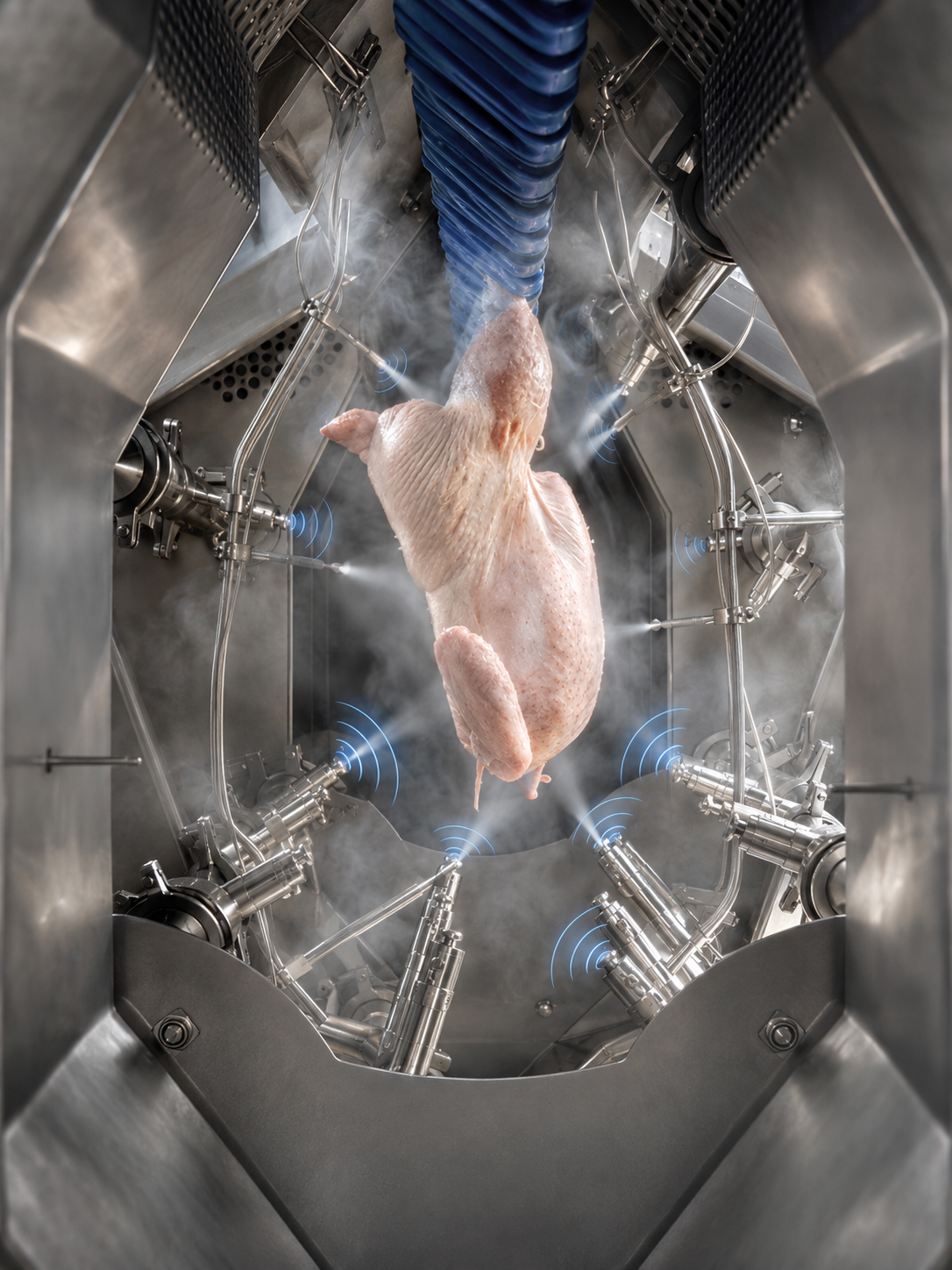
IA Poultry is designed for treatment of broiler carcasses in poultry slaughterhouse facilities. The system targets both internal and external carcass surfaces.

There is no direct contact between the broilers and the treatment equipment, helping to reduce the risk of cross-contamination.

IA Poultry treatment chamber applying steam and ultrasound to a broiler carcass
Specification

Key facts and features

  • Capacity adjustable between 4,000 and 16,000 birds per hour
  • Designed for high-capacity production
  • Non-contact treatment
  • Internal and external carcass treatment
  • Special nozzles producing steam and ultrasound
  • Treatment of the visceral cavity
  • Integrated water cooling
  • Flexible production-line installation
  • Fully automated PLC control
  • Continuous monitoring and logging
  • Ethernet access to process data
  • Data available for HACCP-related process documentation
Documented performance

Documented test results for this application

Fresh broiler carcasses

Campylobacter

More than 90% reduction within 1.4 seconds

Treatment time
1.2–1.4 seconds
Test setting
Industrial poultry line at a Danish slaughterhouse, chain speed 8,500–10,000 birds/hour
log₁₀ CFU/g
Result2.801.43
Before
After
Test details
Target microorganism
Campylobacter
Application
Fresh broiler carcasses
Treatment time
1.2–1.4 seconds
Initial level
Mean 2.80 log₁₀ CFU/g for samples above 2.5 log₁₀ CFU/g
Reduction achieved
1.0 log₁₀ overall; up to 1.37 log₁₀ for higher initial concentrations
Relative reduction
90% overall; up to 96%
Test setting
Industrial poultry line at a Danish slaughterhouse, chain speed 8,500–10,000 birds/hour
Sampling method
Paired sampling of 5 g skin from the left and right side of the carcass breast, corresponding to control and treated. Accredited Campylobacter analysis performed by Eurofins (Holstebro, Denmark).
Number of samples
N=16 for the subset with initial levels above 2.5 log₁₀ CFU/g
Limitations and observations
Reduction levels are highly correlated with the initial Campylobacter concentration. No organoleptic changes were observed in the documented test.
Fresh broiler carcasses

Total Viable Count (TVC)

1.62 log₁₀ reduction — approximately 98% — within 1.4 seconds

Treatment time
1.4 seconds
Test setting
Industrial poultry line at a Danish slaughterhouse, chain speed 8,500–10,000 birds/hour
log₁₀ CFU/12 cm²
Result4.162.54
Before
After
Test details
Target microorganism
Total Viable Count (TVC)
Application
Fresh broiler carcasses
Treatment time
1.4 seconds
Initial level
4.16 log₁₀ CFU/12 cm² (equal to 14,454 CFU/12 cm²)
Reduction achieved
1.62 log₁₀ (4.16 → 2.54 log₁₀ CFU/12 cm²)
Relative reduction
Approximately 98%
Test setting
Industrial poultry line at a Danish slaughterhouse, chain speed 8,500–10,000 birds/hour
Sampling method
Paired sampling by swabbing the surface of the chest skin before and after treatment.
Number of samples
N=24
Broiler carcasses, artificially contaminated

Salmonella typhimurium

Up to 1.0 log₁₀ reduction — up to approximately 90%

Treatment time
Approximately 1.2–1.5 seconds
Test setting
Pilot-scale test using full-size IA Poultry equipment, chain speed 8,000 birds/hour
log₁₀ CFU/g
1.1 initial1.100.80
Before
After
1.5 initial1.500.70
Before
After
1.9 initial1.900.90
Before
After
Test details
Target microorganism
Salmonella typhimurium
Application
Broiler carcasses, artificially contaminated
Treatment time
Approximately 1.2–1.5 seconds
Initial level
Three inoculation levels: 1.1, 1.5 and 1.9 log₁₀
Reduction achieved
0.3, 0.8 and 1.0 log₁₀ respectively
Relative reduction
50–90%
Test setting
Pilot-scale test using full-size IA Poultry equipment, chain speed 8,000 birds/hour
Sampling method
Carcasses two days from slaughter, artificially contaminated with three Salmonella typhimurium inoculations. Paired sampling of 5 g breast skin (control and treated).
Limitations and observations
Artificially contaminated carcasses in a pilot-scale setting, not an industrial-line result.

Results shown are application-specific documented test results. Performance depends on product, surface, process conditions, initial contamination and treatment configuration.

These are results from the documented test configurations. A proof of concept is required to confirm performance for other materials, geometries and operating conditions.

View all documented results
Next step

Request a proof of concept for your application.

A proof of concept confirms suitability for your product, surface, capacity and process conditions.

info@gabutech.com · +45 61 67 31 89